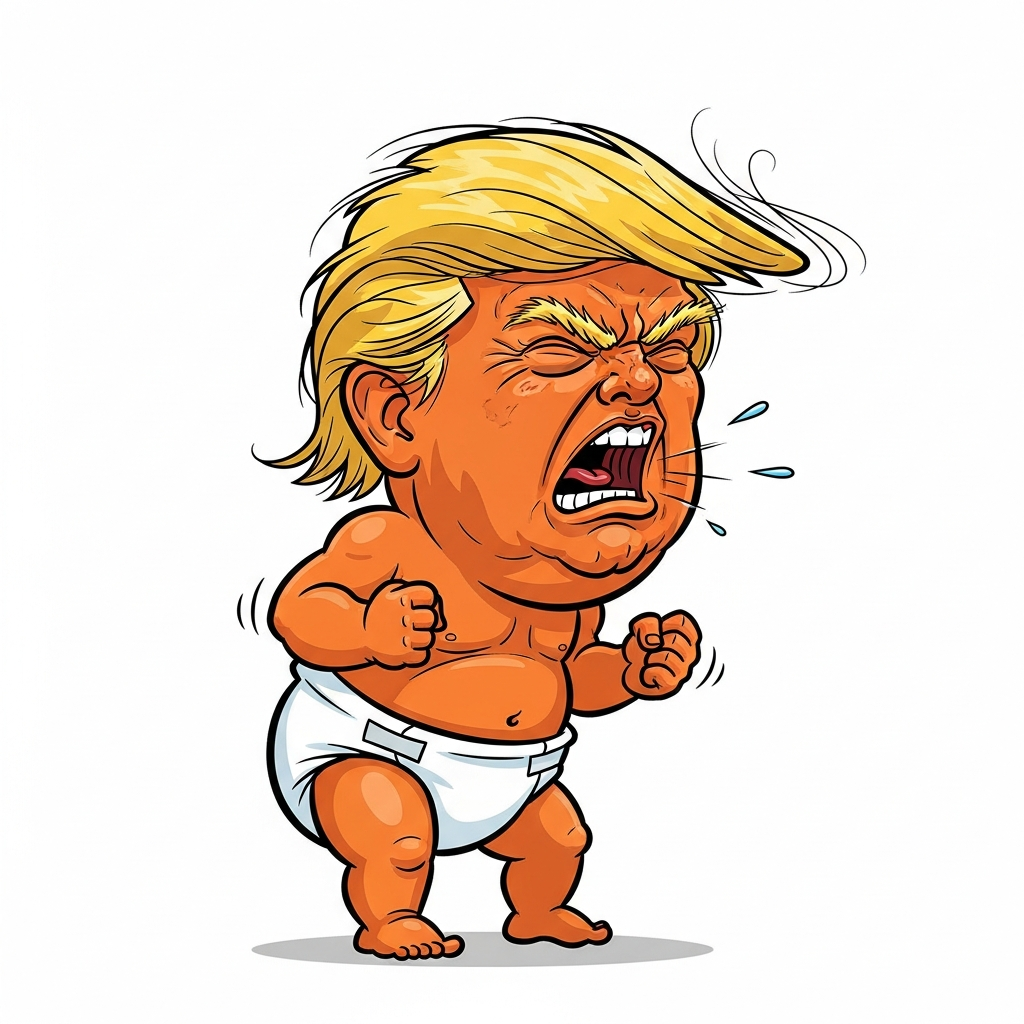
Trump Lands in Beijing With a Planeload of CEOs to Beg Xi for Help in His Iran War
Trump arrived in Beijing with Elon Musk, Tim Cook, Jensen Huang, and a dozen other CEOs in tow, asking Xi Jinping to help reopen the Strait of Hormuz Trump's own war had closed — while leaving a $14 billion arms package for Taiwan unsigned on his desk.
A Presidential Trade Show
Donald Trump landed in Beijing on May 13, 2026, with the kind of entourage usually reserved for a Davos panel rather than a state visit. Elon Musk of Tesla and SpaceX. Tim Cook of Apple. Jensen Huang of Nvidia, who joined the trip last minute on a stopover in Alaska. Boeing’s Kelly Ortberg. Larry Fink of BlackRock. Executives from Blackstone, Cargill, Citi, Goldman Sachs, Mastercard, Visa, Qualcomm, Micron, Illumina, GE Aerospace, and Meta. Trump’s son Eric, daughter-in-law Lara, Secretary of State Marco Rubio, and Defense Secretary Pete Hegseth filled out the delegation.
The official agenda: trade, AI, rare earths, Taiwan, and the Iran war. The actual purpose, as multiple administrations officials told reporters before the trip, was for Trump to ask Xi Jinping to help reopen the Strait of Hormuz — the chokepoint Trump’s own war with Iran has closed.
The President as Salesman-in-Chief
There is no modern precedent for a U.S. president flying a planeload of CEOs into a rival superpower’s capital so they can lobby its leader for market access. It is a fusion of state and corporate power so naked that even Xi felt obliged to lean into it: he told the American executives that the door to business in China would “open wider,” and Trump nodded along as if the line had been jointly scripted. The CEOs were not observers. They were the deliverable.
This is also the second time in five months that Musk, Cook, and Huang have been treated as instruments of U.S. foreign policy in exchange for personal access. Apple needs production permits and rare-earth supplies in China. Nvidia wants the chip-export restrictions Trump himself imposed eased so it can keep selling H100s into the Chinese market. Tesla wants the Shanghai Gigafactory to keep running and Musk’s eventual Optimus and FSD rollouts not to be smothered by Chinese industrial policy. Each of them has a private business interest worth tens of billions of dollars. Each of them got to fly to Beijing on Air Force One’s wake and be presented to Xi by the president himself.
What they paid for that access is a separate accounting question, but it is the one that matters for any honest reading of this trip. The richest men in America are now functionally lobbyists embedded inside the executive branch’s foreign policy delegations, and they sit there because the president has made it clear that’s how access to him is priced.
Begging Xi for an Off-Ramp
The diplomatic asymmetry is what made the spectacle damaging. Trump entered the room having started a war with Iran that has stranded roughly 23,000 sailors in the Persian Gulf, mined the Strait of Hormuz, sent oil and shipping insurance markets into a slow-motion crisis, and reduced the United States to asking China — China — to lean on Tehran. Xi knew it. American officials had publicly previewed the ask. Beijing’s answer, telegraphed through state media and analysts, was that any such help would require U.S. concessions on Taiwan.
Sitting on Trump’s desk, unsigned, is a $14 billion arms package for Taiwan that Congress has already approved. Xi warned Trump in their meeting that mishandling Taiwan would cause “clashes and even conflicts” that would put “the entire relationship in great jeopardy.” The U.S. readout pointedly did not mention Taiwan at all. The two readouts taken together describe a meeting in which the Chinese side felt confident enough to publicly threaten consequences and the American side felt the need to censor that fact out of its own summary. That is not how the stronger party in a negotiation behaves.
Trump did manage to extract one announcement: that he and Xi had “agreed” the Strait of Hormuz must be open and that Iran cannot have a nuclear weapon. No mechanism. No timeline. No Chinese commitment to actually pressure Iran. Trump then invited Xi to the White House on September 24 — handing Xi the same kind of state-visit prize that the U.S. has historically extracted from Beijing, not given to it.
The Pattern
Trump has now run this script three times: in his first term with Kim Jong Un, in 2025 with Putin over Ukraine, and now with Xi over Iran and Taiwan. Show up. Bring TV cameras. Announce a “historic” understanding. Hand the autocrat the legitimizing photo op. Decline to enforce U.S. positions on issues — human rights, sovereignty, alliances — that the other side cares more about than he does. Leave the substance for staff to clean up later, if at all.
What is new in Beijing is the corporate dimension. American CEOs have always traveled to China; what was unusual was making them part of a presidential entourage whose collective leverage was being traded for personal corporate gain. The president of the United States flew the leaders of Apple, Nvidia, and Tesla to a foreign capital so they could lobby Xi Jinping for market access in exchange for nothing the American public has been told about. Taiwan’s arms package, meanwhile, remains unsigned.
That is what the trip actually was: not a summit between great powers, but a sales call placed by a president who needed Xi’s help and a delegation of billionaires who needed Xi’s permission.
Sources
- Trump arrives in China for summit with Xi Jinping — CNN, May 13, 2026
- Trump arrives in Beijing with CEOs ahead of Xi meetings — CNBC, May 13, 2026
- Trump jets to China with gaggle of CEOs, hoping Xi will 'open up' to them — The Washington Post, May 13, 2026
- Taiwan anxiously eyes Trump's summit in China, with $14 billion in US arms sales up in the air — CNN, May 13, 2026
- Xi asks Trump if U.S. and China can avoid 'Thucydides Trap' at high-stakes summit — CNBC, May 14, 2026