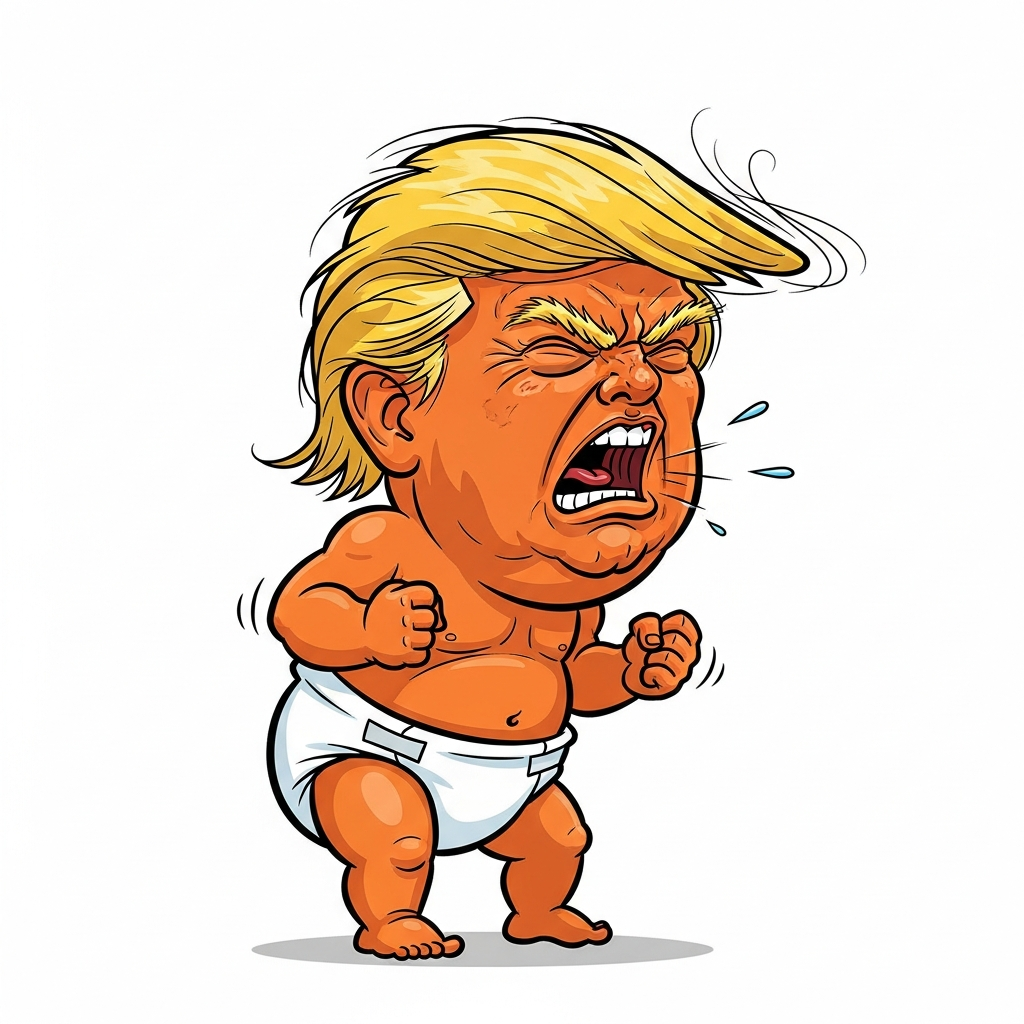
Trump to Drop $10B IRS Lawsuit for Control of $1.7B Taxpayer Slush Fund to Pay Himself and Jan 6 Defendants
Trump is poised to drop his $10 billion lawsuit against the IRS in exchange for the creation of a $1.7 billion 'weaponization' fund — controlled by a commission he can fire at will — that can hand taxpayer money to nearly 1,600 Jan. 6 defendants and entities tied to Trump himself, with no obligation to disclose how decisions are made.
The Scheme
President Trump filed a $10 billion damages claim against the IRS earlier this year, alleging that the Biden administration had “weaponized” the agency against him through investigations and audits. On May 16, multiple outlets reported that the administration is now preparing to drop that suit in exchange for something more useful than money: a $1.7 billion compensation fund that Trump himself effectively controls.
Under the terms being negotiated, the fund would be administered by a commission whose members Trump can remove without cause. The commission would have authority to hand out taxpayer money to anyone claiming they were “wrongfully targeted” by the Biden administration. It would be under no obligation to disclose its procedures or its decisions.
The fund would be drawn from the Treasury Department’s Judgment Fund — a permanent appropriation used to pay government settlements. Congress would have no say in approving the payouts.
Who Gets Paid
The class of eligible recipients is the part that turns the deal from corrupt into spectacular. According to ABC News and TIME, the fund’s reach includes:
- The roughly 1,600 individuals charged in connection with the January 6, 2021 attack on the U.S. Capitol — the same defendants Trump already pardoned on his first day in office, many convicted of assaulting police officers.
- Other “allies” who allege they were investigated, prosecuted, or audited under Biden.
- Entities associated with President Trump himself.
In other words: Trump is suing his own government, dropping the suit in exchange for a fund he controls, and then writing himself and his pardoned rioters into the list of beneficiaries. The money does not come from the people who allegedly did the targeting — it comes from American taxpayers.
Even His Own People Are Uneasy
ABC News reported that the proposal has prompted some administration officials to raise internal ethical concerns — not over the underlying claim of “weaponization,” but over the structural absurdity of the president suing his own government, settling that suit with himself, and then administering the proceeds without oversight. They are not wrong to be alarmed. There is no analogue for this arrangement in modern American government.
House Judiciary Ranking Member Jamie Raskin called it a “$1.7 billion taxpayer-funded slush fund for MAGA loyalists.” The New Republic was blunter, describing the deal as a “shakedown” that has taken “an unnervingly corrupt turn.” Both descriptions are accurate, and neither captures the full picture: this is not a settlement, it is a self-dealing transfer engineered to convert a political grievance into a permanent stream of public money flowing to the president’s friends, his rioters, and himself.
The Pattern
This is the same pattern that runs through every major Trump initiative in 2025 and 2026. He attacks an institution as “weaponized” — the IRS, DOJ, the FBI, federal judges, state election systems — uses the claim to extract a concession, and engineers that concession to consolidate his own control and reward those who have been loyal to him personally. The Cuba sanctions order in May rewarded a hardline donor base. The Medicaid withholding from California punished a state that defied him. The Jan. 6 pardons rewarded the foot soldiers of the 2021 coup attempt. This deal rewards them again — this time with cash.
The Judgment Fund exists to pay legitimate government settlements. It is being repurposed here as a tip jar for a criminal enterprise that already controls the executive branch. There is no judicial check, because no court approved the underlying claim. There is no congressional check, because the Judgment Fund does not require appropriation. There is no internal check, because Trump can fire the commissioners at will.
Why It Matters
A president cannot lawfully use the Treasury as his personal payout fund for political allies and convicted insurrectionists. Doing so is the textbook definition of “Taking the property of the people of the United States and giving it to the President’s friends” — the kind of conduct that, in another century, would have been impeachment material in any party. In 2026, with Cassidy losing his primary the same weekend for having voted to convict Trump five years ago, it will instead be celebrated by the House GOP as a victory over the “deep state.”
The $1.7 billion is, on a federal scale, small. The precedent is enormous. Once a president can sue his own government, settle with himself, and direct the proceeds to his own pardoned foot soldiers, there is no longer a meaningful boundary between public money and the president’s private patronage network. That is the boundary the framers cared most about. It is the boundary this deal erases.
Sources
- Trump poised to drop IRS suit, launch $1.7B 'weaponization' fund for allies: Sources — ABC News, May 16, 2026
- Trump May Drop IRS Suit in Return for $1.7 Billion 'Weaponization' Fund — TIME, May 16, 2026
- Trump's $10 Billion Shakedown of IRS Takes Unnervingly Corrupt Turn — The New Republic, May 16, 2026
- Trump's IRS suit may end with a $1.7 billion compensation fund — Fortune, May 16, 2026
- Ranking Member Raskin's Statement on Trump's $1.7 Billion Taxpayer-Funded Slush Fund for MAGA Loyalists — U.S. House Judiciary Committee Democrats, May 16, 2026